General
Evacusafe Excel vs Evac+Chair 300H: Which Is Better for Schools?
By Evacuation 360 · Published 3 November 2026
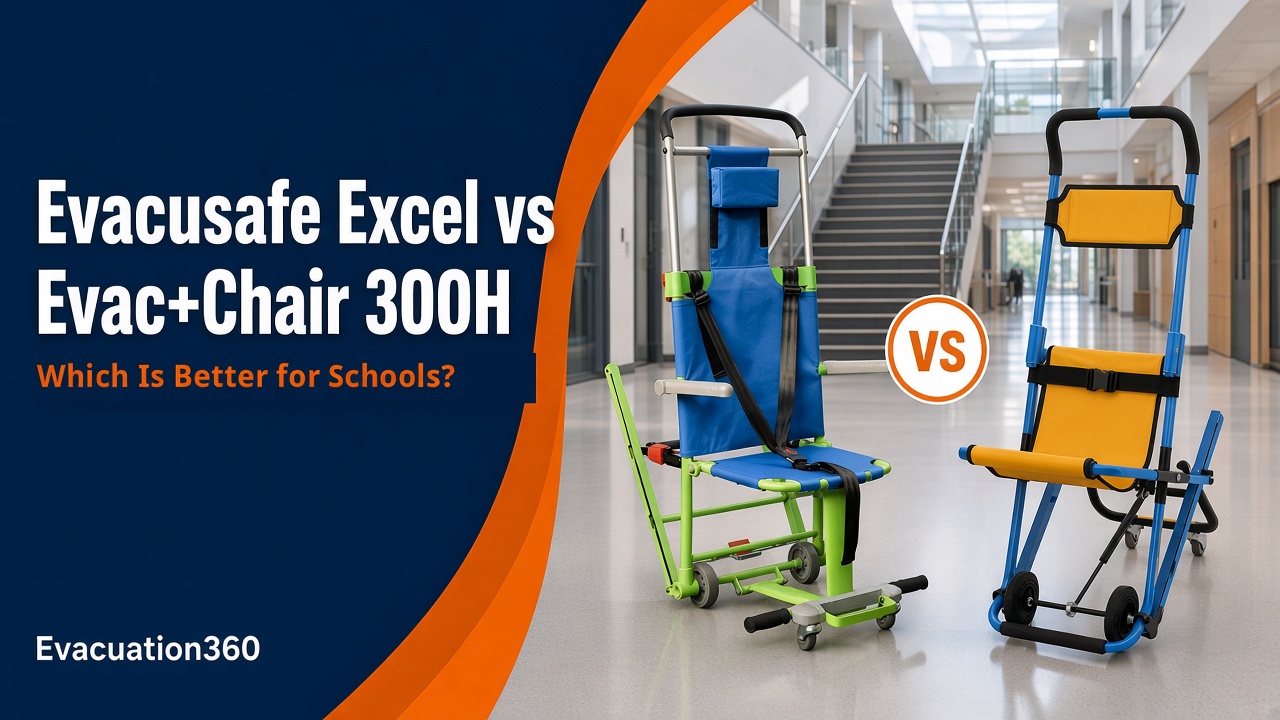
Evacusafe Excel vs Evac+Chair 300H: Which Is Better for Schools?
Evacuation360 supplies evacuation chairs from a range of manufacturers. We are affiliated with The Emergency Group, which supplies Safety Chair, Evacusafe and Escape Mobility products in the UK, and Evac+Chair products in the US. This guide reflects our views and practical training experience.
Choosing an evacuation chair for a school is about much more than finding a product that can descend a staircase.
For a pupil who uses a wheelchair, the transfer into the evacuation chair can be just as important as the journey down the stairs. For the school, there are further questions: how quickly can the chair be deployed, how easy is it for staff to learn, how many trained people need to be available, and how practical will the whole process be in a real emergency?
Two of the best-known options for UK schools are the Evacusafe Excel and the Evac+Chair 300H MK5. Both are designed to help people with reduced mobility during emergency stair evacuation, but they differ significantly in how they are deployed, how passengers transfer into them and what operators need to learn.
For many school environments, we believe those differences give the Evacusafe Excel some important practical advantages.
At a Glance
| Feature | Evacusafe Excel | Evac+Chair 300H MK5 |
|---|---|---|
| Chair set-up | 2 steps | 6 steps |
| Maximum load | 227kg | 182kg |
| Seat | Wide, flat, open seat | Contoured hammock-style seat |
| Weight-bearing armrests | Yes | No equivalent |
| Passenger support | 3-point harness | Hammock seating and restraint |
| Level-floor operation | 4 permanently deployed wheels | 2-wheel and 4-wheel configurations |
| Kickstand | Not required | Used to move to 4-wheel operation |
| During transfer | Chair secured by rear brake | Operator holds chair near-upright |
| Operator during transfer | Free to assist the passenger | Hands-on controlling the chair |
| Operator training | Typically around 50% shorter in our experience | More procedures to learn |
| Stair descent | Friction-controlled tracks | Friction belt system |
This comparison relates to the UK Evac+Chair 300H MK5. Specifications are based on manufacturers' published information. Operational comparisons are based on each product's operating procedures and our experience training operators across multiple brands.
Wheelchair Transfers: One of the Biggest Differences
Some pupils can transfer independently, some can help with their own transfer, and others need considerably more support. The design of the chair has a real impact on how practical that transfer is.
The Excel has a flat, open seat that gives a familiar seating position and clear access. Its weight-bearing armrests allow a suitable wheelchair user with enough upper-body strength to support their own weight as they move across.
The 300H uses a contoured, hammock-style seat instead.
What is the operator doing during the transfer?
This is perhaps the most important practical difference.
The Excel can be positioned and secured using its rear-wheel brake. The operator does not need to hold the chair upright, so they are free to help the passenger during the transfer.
With the 300H, the operator holds the chair in a near-upright position and stays hands-on to control it while the passenger transfers into the seat. The kickstand is not used to support the chair at this stage. So where a pupil needs physical help to transfer, an additional member of staff may be required, which is an important consideration when writing a Personal Emergency Evacuation Plan (PEEP).
Why This Matters in a School
In an evacuation, staff are quickly stretched. Teachers and teaching assistants may be responsible for other pupils, and sickness, holidays, timetable changes and staff turnover all affect who is available on the day. A procedure that relies on several specific people being present needs careful thought.
With the Excel, one trained operator can secure the chair and then, where the pupil's transfer assessment allows, help them into it.
The individual pupil's needs always come first. The right transfer method and the number of staff needed should be set out in the pupil's PEEP and moving and handling assessment.
Two-Step vs Six-Step Set-Up
Simplicity matters in an emergency.
The Excel has a two-step set-up, and its four wheels are permanently deployed, so there's no need to change the wheel configuration before moving across level floors.
The 300H MK5 has a six-step set-up, and operators must be competent in both its two-wheel and four-wheel configurations, including deploying the kickstand.
The 300H's system is well established and works. The difference is one of operational complexity. A professional who uses equipment daily may find the extra stages easy, but a teacher who practises occasionally has to remember them under pressure, with alarms sounding and frightened pupils around them. In that environment, we believe keeping things simple is a genuine advantage.
Why Excel Training Typically Takes Around 50% Less Time
Based on our records of delivering practical evacuation chair training, Excel operator training typically takes around 50% less time than training on the Evac+Chair 300H.
The reason is straightforward. With the Excel, operators learn a two-step set-up, one consistent four-wheel arrangement, passenger transfer and controlled stair descent. With the 300H, they also learn a six-step set-up, two-wheel operation, four-wheel operation, kickstand deployment and the transition between configurations.
Our figure is based on our own training records rather than an independent study, and actual course length will depend on the delegates and circumstances.
Shorter training does not mean a lower standard. Every operator still receives practical instruction and must demonstrate competence. For schools, it means less time out of the classroom and makes it easier to train more staff, so evacuation plans depend less on one or two individuals being present.
Four Permanently Deployed Wheels
An evacuation doesn't start at the top of the stairs and end at the bottom. A pupil may need to travel through a classroom, along corridors and across landings to reach a place of safety.
The Excel's four permanently deployed wheels let it move across level surfaces without any change of configuration, and its rear-wheel brake helps when positioning the chair and during transfers. The 300H requires operators to switch between two-wheel and four-wheel modes using its kickstand. Both approaches work, but for staff who use the equipment only occasionally, one consistent set-up has real value.
Passenger Support, Comfort and Dignity
Every pupil is different, and the equipment must suit the individual. The Excel includes:
- A three-point adjustable harness over the shoulders and between the legs, which helps people with reduced core strength
- A wide, flat seat with good access for transfers
- Weight-bearing armrests
- Padded head support
- Footrest and additional leg support
- Full-length back support
The 300H takes a different approach, built around its contoured hammock seat and restraint system. Neither will suit everyone. Equipment should be chosen around the person who will use it, not the other way round.
227kg vs 182kg Maximum Load
The Excel is rated to 227kg, while the UK 300H MK5 is rated to 182kg. For most pupils, either is more than enough, but school equipment may also need to serve staff, parents and visitors, so the higher capacity adds flexibility.
The 300H is lighter than the Excel, which may be an advantage where equipment weight is a key concern. Both chairs fold for wall storage.
Why This Matters: No Student Left Behind
Our interest in school evacuation goes far beyond selling chairs.
The Emergency Group has been working alongside Lucas Vezza-O'Brien and supporting his No Student Left Behind campaign. Lucas is a wheelchair user who was at Hyde High School when a fire incident occurred in November 2024. While his classmates evacuated, Lucas was unable to leave the upper floor because suitable evacuation arrangements weren't in place.
His experience raised a simple but important question: why should a disabled pupil have a different chance of reaching safety from their classmates?
Lucas's campaign gathered more than 100,000 signatures, and the issue of evacuation chairs in schools and colleges was debated in Parliament on 1 December 2025. The Emergency Group has supported the campaign by providing evacuation equipment and training to his school and helping raise awareness, including through engagement with government.
The Evacusafe Excel was the chair chosen for Lucas, for the reasons set out in this guide: its flat, open seat and weight-bearing armrests suit his transfer, it can be secured so the operator is free to assist him, and its simpler operation means more staff can be trained to use it confidently.
The goal is bigger than putting chairs on walls. It is about making sure schools properly consider:
- Personal Emergency Evacuation Plans
- The individual needs of disabled pupils
- Appropriate evacuation equipment
- Staff training and the availability of trained operators
- Practical evacuation, not plans that only exist on paper
A pupil who can get into a school to learn should also have a practical way of getting out in an emergency. Accessibility should work both ways.
What Does UK Law Require Schools to Do?
There is no blanket legal requirement for every UK school to have an evacuation chair. However, schools do have duties around fire safety, emergency evacuation and the needs of disabled people using their buildings.
The Regulatory Reform (Fire Safety) Order 2005 requires the responsible person to take appropriate fire precautions and put suitable emergency procedures in place. Schools must also meet their duties under the Equality Act 2010, including making reasonable adjustments.
For anyone who may not be able to evacuate independently, a PEEP sets out how they will reach safety. Depending on the individual, it may cover:
- The evacuation route
- Suitable evacuation equipment
- Transfer arrangements
- Trained staff and how many are needed
- Alternatives where an evacuation chair isn't suitable
An evacuation chair should never simply be bought and hung on a wall without considering who will need it and how it will actually be used.
What Should a School Consider When Choosing a Chair?
No single chair suits every pupil, staircase or school. Before choosing, consider the pupil's ability to transfer, whether they need physical help, their support needs, the staircase layout, corridor and landing sizes, the availability of trained staff and where the chair will be stored. The chair should then form part of the pupil's PEEP and the school's wider evacuation arrangements.
So, Which Is Better for Schools?
Both are established chairs, and both provide effective assisted stair descent when correctly selected and operated. The 300H is lightweight and compact and has been widely used across the UK.
For many schools, though, we believe the Evacusafe Excel offers significant practical advantages:
- Easier transfers for many wheelchair users: a flat, open seat, weight-bearing armrests and a braked chair leave the operator free to help.
- Two-step rather than six-step set-up: fewer procedures for staff to learn and remember.
- One consistent four-wheel arrangement: no switching between two-wheel and four-wheel modes.
- Typically around 50% less training time: based on our training records.
- Higher maximum load: 227kg compared with 182kg.
Don't Just Choose a Chair. Test the Plan.
The most important question isn't "Which chair should we buy?"
It's: "Could we safely evacuate this pupil, from this part of our building, with the staff who will realistically be available?"
Schools don't need to wait for legislation to change before reviewing their arrangements. If a disabled pupil, member of staff or visitor can't use the stairs independently, ask yourself how you would get them out today. If the answer isn't clear, it's time to review the plan.
Because accessibility isn't only about getting into a building. It's also about being able to get out.
Frequently Asked Questions
What's the difference between the Evacusafe Excel and the Evac+Chair 300H? The main differences are set-up, passenger transfer, seating, wheel configuration and maximum load. The Excel has a two-step set-up, four permanently deployed wheels, a flat open seat, weight-bearing armrests and a 227kg capacity. The UK 300H MK5 has a six-step set-up, two-wheel and four-wheel configurations, a hammock-style seat and a 182kg capacity.
Which is better for schools? Both are designed for assisted stair evacuation, but we believe the Excel offers several advantages for many schools: simpler set-up, one consistent wheel arrangement, and a transfer process that leaves the operator free to help. The right chair should always be chosen around the individual pupil, route and building.
Which is easier for wheelchair transfers? For many wheelchair users, we believe the Excel is more practical. Its flat seat and weight-bearing armrests help the transfer, and its rear brake means the operator can assist rather than hold the chair. With the 300H, the operator keeps hands-on control of the chair during transfer. Individual needs should always be assessed in the person's PEEP and moving and handling assessment.
How many steps does it take to set up each chair? The Excel takes two steps. The UK 300H MK5 takes six, and operators also need to learn its two-wheel and four-wheel configurations and kickstand.
Does the Excel take less time to train staff on? In our experience, yes. Based on our training records, Excel operator training typically takes around 50% less time than 300H training, because there are fewer deployment stages and no wheel configurations to switch between. This is based on our own records, not an independent study.
What's the maximum weight capacity? The Excel is rated to 227kg, and the UK 300H MK5 to 182kg.
Can one person operate the Excel? Yes. One trained operator can carry out a normal stair descent. Whether extra help is needed depends on the passenger, their transfer needs, the route and their PEEP. A chair being operable by one person never means every individual can be transferred and evacuated by one person.
Do schools legally need evacuation chairs? There's no blanket legal requirement, but schools must have suitable evacuation arrangements for everyone using their buildings. Where someone's arrangements require an evacuation chair, the school needs to make sure one is available, along with trained staff.
What is a PEEP? A Personal Emergency Evacuation Plan sets out how someone who can't evacuate independently will reach a place of safety. For a pupil with reduced mobility, it may include the route, transfer arrangements, equipment, staff assistance and the number of trained people needed.
Should a school choose a chair before completing a PEEP? Ideally not. Assess the individual's needs and evacuation route first, then choose equipment as part of that plan.
How This Comparison Was Prepared
This comparison covers the UK Evac+Chair 300H MK5 and the Evacusafe Excel as available in the UK at the time of publication. Specifications have been checked against current manufacturer information and operating documentation. The set-up and transfer comparisons are based on each product's operating procedures. The training-time figure is based on our own training records and is not the result of an independent study.
Individual requirements vary. Schools should carry out an appropriate assessment before choosing evacuation equipment, and transfer and evacuation arrangements should form part of the relevant risk assessment and PEEP.
Need advice for your building?
Talk to us →